On 2026-11-11 the ETC Cooperative announced that it has begun winding down its operations, and expects most of the dissolution to be done by the end of 2026. One line of the announcement is about Diego, co-founder of Classix.
As part of the wind-down, Diego López León’s role concluded on November 7, 2026. We are deeply grateful to Diego for all of his contributions over the years.
We are pleased to announce that this work will carry on at Classix, where Diego will keep maintaining Ethereum Classic’s clients for at least another twelve months. That covers Core-Geth, the Go client most of the network runs, and the other clients he maintains alongside it.
From the Cooperative to Classix
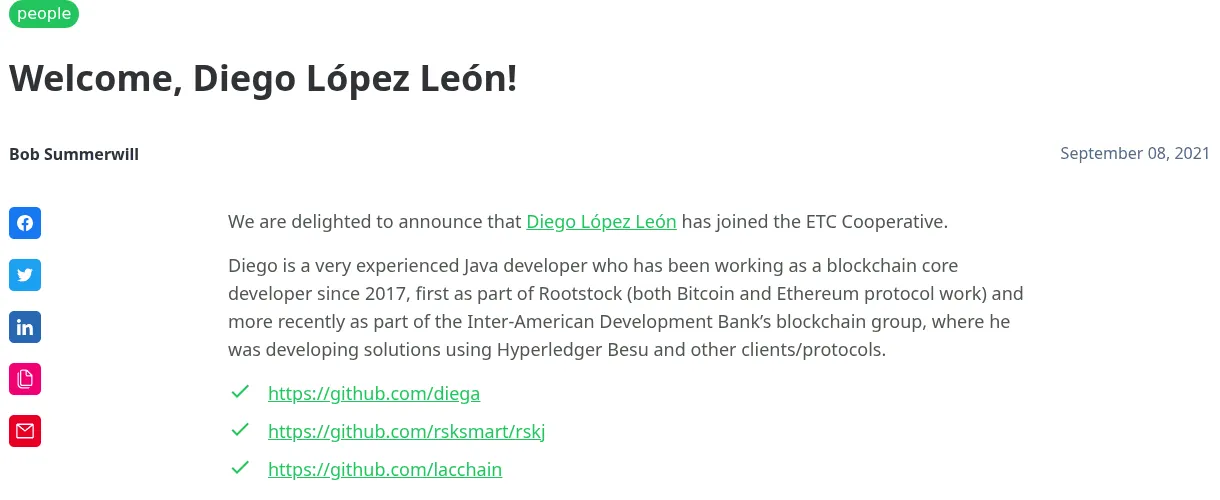
Diego joined the ETC Cooperative in September 2021 as its first full-time core developer, hired to work on the Besu client. Three months later the Cooperative took on Core-Geth as well, and Diego joined the two Core-Geth developers in one team that looked after both clients.
The Coop team got smaller after that. At the end of 2024 it went from three core developers to two, and by the middle of 2025 Diego was the only one.
Earlier this year, a Cooperative board member announced that the Cooperative would be winding down this year, and in response, Classix was born. In The Next Chapter, we explain how and why Classix is picking up the torch from the Cooperative. As we wrote when we introduced the founders in Hello, Classix,
Diego López León is currently the only core maintainer of the Ethereum Classic clients. […] Classix exists to ensure that this work continues, and we will support it for the foreseeable future.
This is what picking up the torch looks like.
The Mumbai Commitment
Diego and Istora were both in Mumbai in the first week of November for Devcon 8. On 2026-11-02, the evening before it opened, we hosted an Ethereum Classic meetup, and Diego gave one of the three talks, Ethereum Classic Clients.
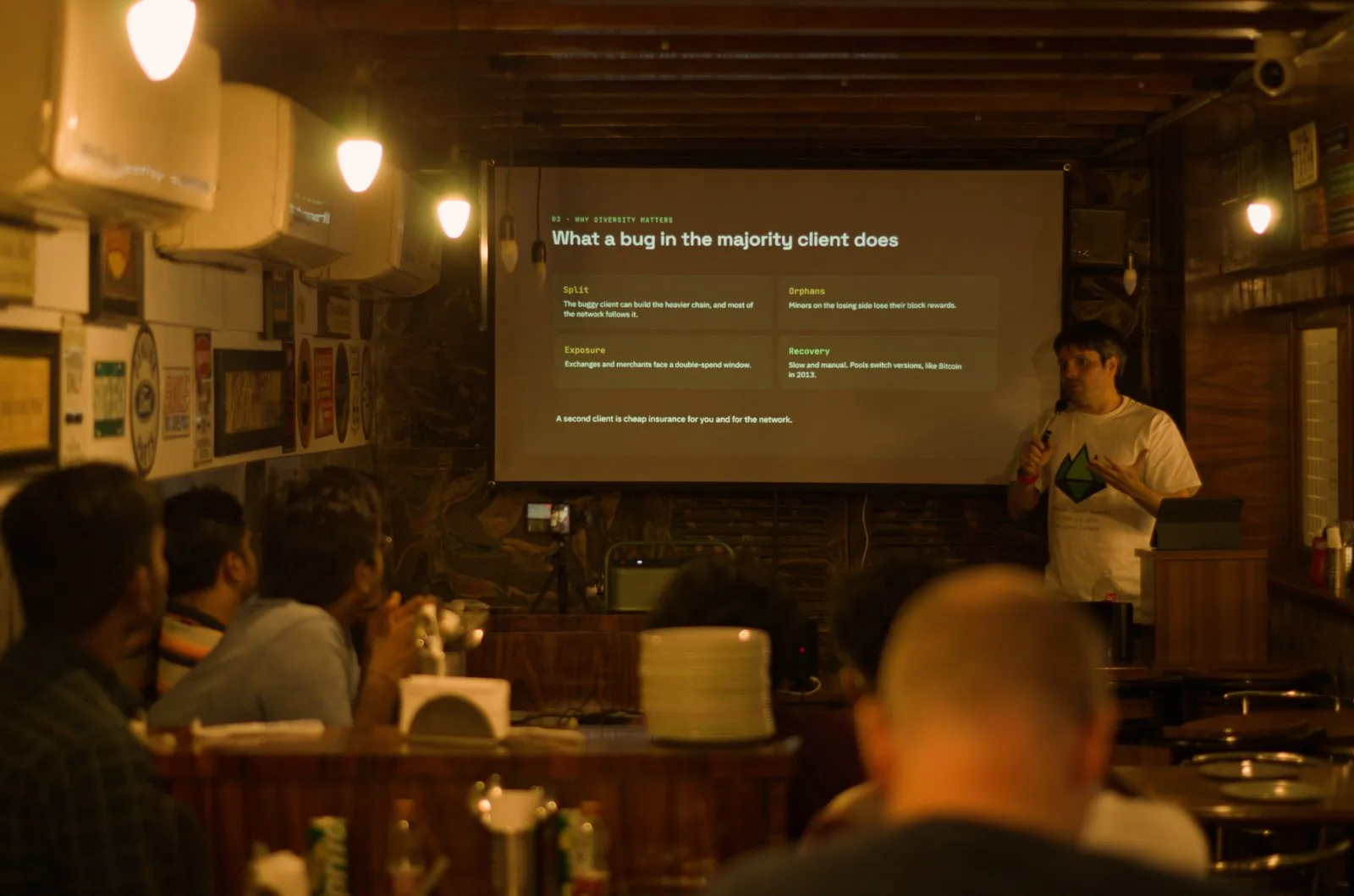
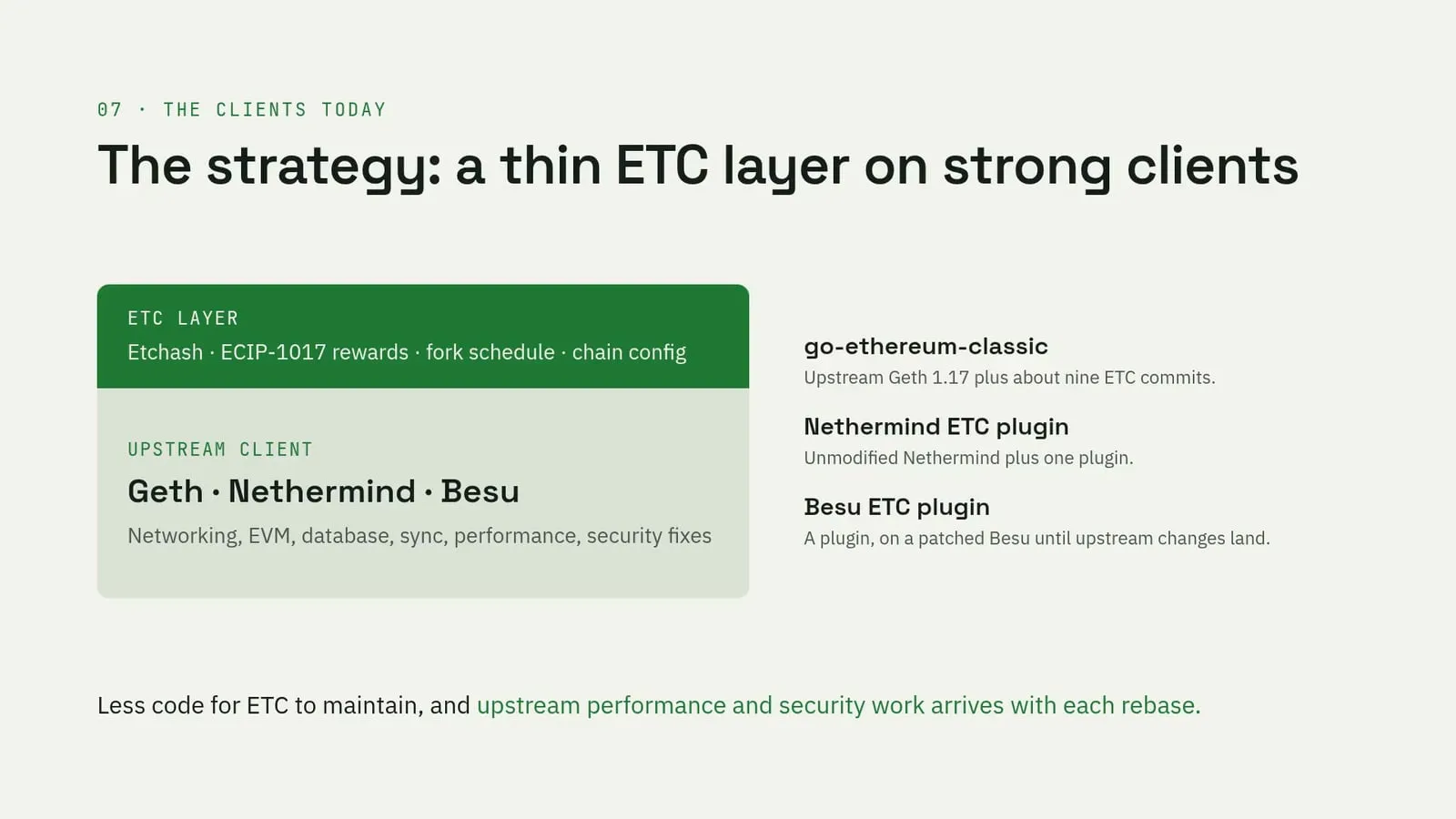
The main takeaway was that ETC needs more than one client. Today 94% of reachable ETC nodes run Core-Geth, and Diego called running a minority client “a cheap and easy insurance”. His strategy is to build each ETC client as a thin layer of ETC rules on a strong upstream client, which his slide sums up as “Less code for ETC to maintain, and upstream performance and security work arrives with each rebase”.
There is little more fundamental, or of more critical importance, than core client development. Classix is committed to supporting ETC and to guaranteeing that this important work continues. In Mumbai, an agreement was made to support Diego’s work for at least another twelve months, and we expect it to carry on after that.
What Diego Shipped in 2026
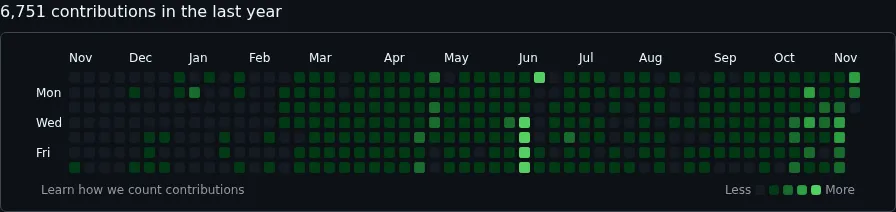
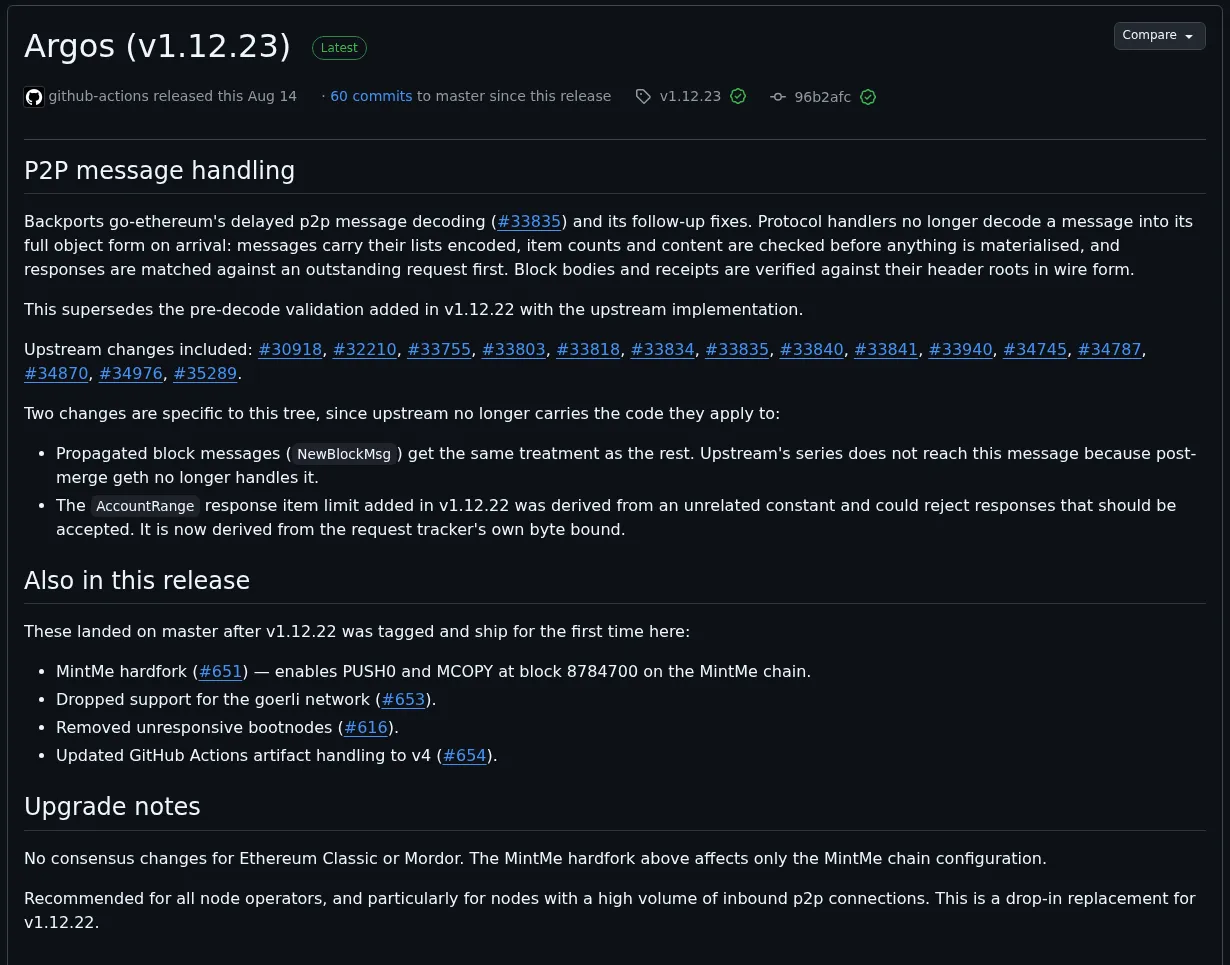
Core-Geth had three releases this year and Diego cut all of them. Aegis (v1.12.21) in March was a security hotfix for a P2P crash-loop, and Hermes (v1.12.22) followed ten days later with upstream CVE backports. Argos (v1.12.23) came out on 2026-08-14. Since then the Core-Geth work has been on the toolchain, CI and documentation.
Go Ethereum Classic (getc) is Diego’s newer Go client, built on current go-ethereum, and one of the four clients that run the Project Triforce nodes. Its first tag is from March, and by August it had followed go-ethereum to v1.17.4-etc.1.
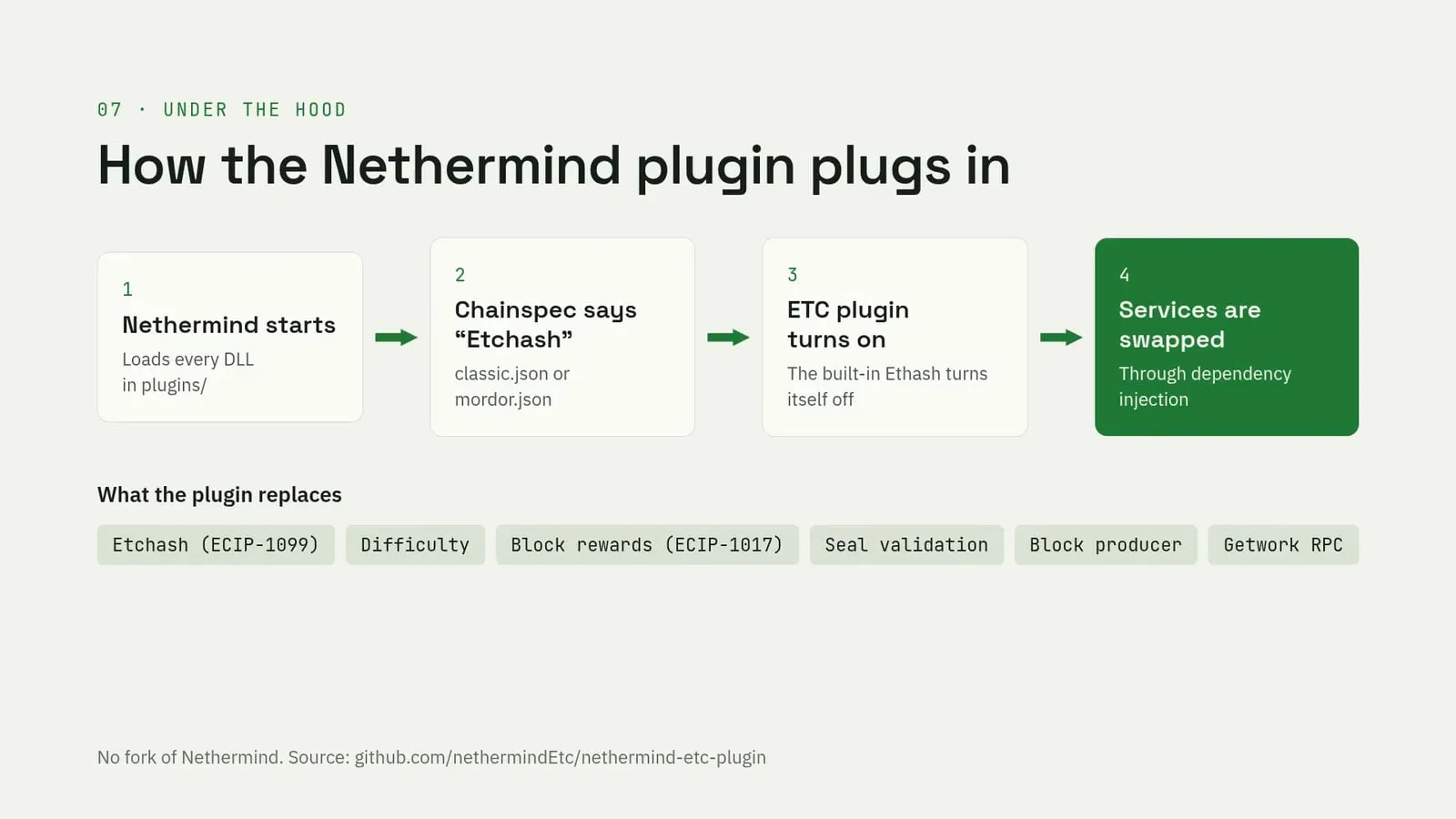
The Nethermind ETC plugin adds ETC to an unmodified Nethermind by swapping in six services (the Etchash proof-of-work algorithm, difficulty, block rewards, seal validation, block production and the getwork RPC) and leaving the rest of the client alone. This year it was ported to Nethermind 2.0, and it now builds a new release automatically for each Nethermind release, most recently v2.2.2.0 on 2026-10-26.
The month by month detail of Diego’s client maintenance, as well as all the work we do publicly at Classix, is in our activity reports.
Besu Upstream and the ETC Plugin
Diego fixed three full sync stalls in upstream Besu this year (#10047, #10235 and #10220), all of them in blocks from 2016.
Besu no longer has to support ETC directly. Diego created a plugin system for it, so ETC’s rules now live in the Besu ETC plugin and everything else stays stock Besu. This is a massive win, because ETC keeps a Besu client and Besu carries no ETC code.
Besu doesn’t yet have a supported way for a plugin to change the protocol schedule, so for now the plugin runs on besu-etc/besu, a Besu fork that adds the missing extension points.
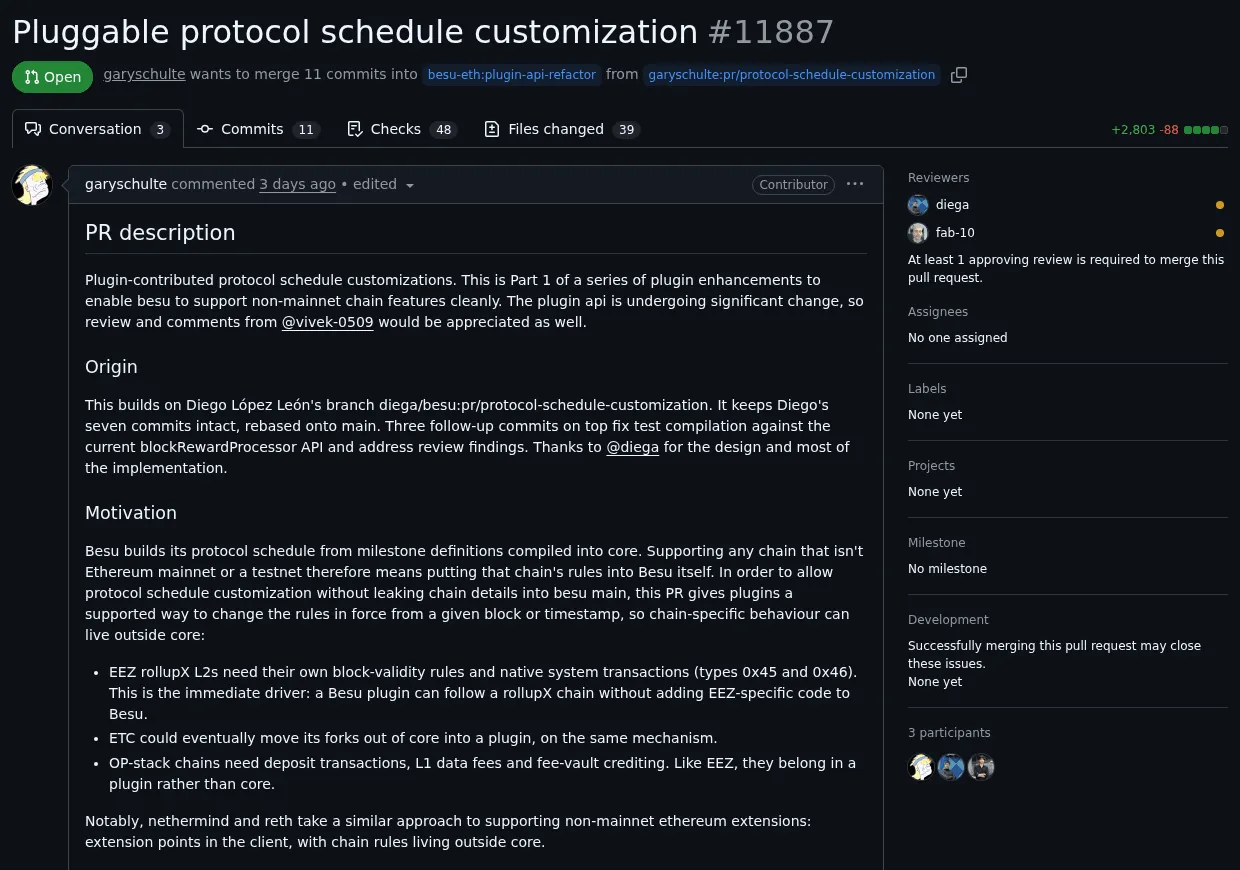
That extension point is now proposed for Besu itself. Gary Schulte, one of Besu’s leads, opened PR #11887, Pluggable protocol schedule customization, on 2026-11-07, and most of the code in it is Diego’s.
This builds on Diego López León’s branch diega/besu:pr/protocol-schedule-customization. It keeps Diego’s seven commits intact, rebased onto main. Three follow-up commits on top fix test compilation against the current blockRewardProcessor API and address review findings. Thanks to @diega for the design and most of the implementation.
Since the pull request was created by a Besu lead developer, we expect it to be merged in the near future.
Once the extension points are in a Besu release, ETC stops needing a Besu fork, and the ETC rules ship as a plugin JAR that loads into an unmodified Besu. Picking up a new Besu release then means rebuilding and testing the plugin, where today it means rebasing ETC’s changes onto Besu’s and resolving the conflicts every time.
What the Next Year Covers
The twelve month commitment is first about maintaining the four clients Diego looks after today, which are Core-Geth, Go Ethereum Classic, the Besu ETC plugin and the Nethermind ETC plugin. We’re thinking about adding a fifth next year.
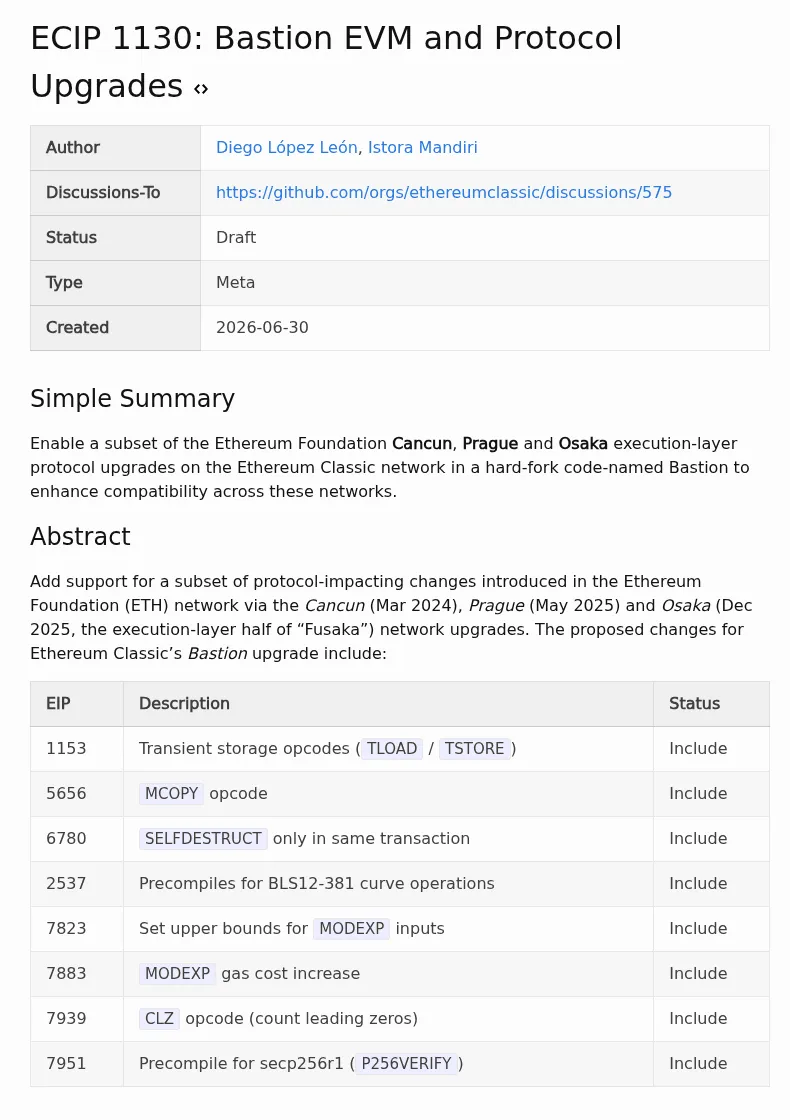
Second, Diego will continue his role as ECIP Editor. He is also one of the authors of Bastion (ECIP-1130), the next fork proposed for ETC, which would enable a subset of Ethereum’s Cancun, Prague and Osaka upgrades. The next major challenge will be ECIP-1120, the streamlined fee mechanism, and a pathway to bring ETC into the post-quantum era with what we learned at Devcon.
We also came home from Mumbai with ideas that touch the clients, and The Idea Harvest has the full list. One is a unified AI upgrade pipeline, where agents take on the job of upgrading each client to new versions of its upstream, and porting an ECIP across the clients comes second. Another is Lean 4, the language Ethereum’s cryptography work is moving into, which we’ll be experimenting with. On quantum security there is an ETC strawmap on the way and leanSPHINCS, the hash-based signature that ETC would need a hard fork to adopt.
They are still ideas. The trip feeds into our 2027 pathway, which we’ll announce next month.
If you run a node or a mining pool and want to talk about any of this, write to [email protected].
Thank you, Diego, for the work and for the trust you have placed in Classix. Thank you as well to Isaac Ardis and Chris Ziogas, who maintained Core-Geth alongside him at the Cooperative. Ethereum Classic has depended on all three of them.