Istora and Diego from Classix were at TOKEN2049 in Singapore last week. We went to listen, to meet people building the wider cryptocurrency ecosystem, and to find out where ETC fits in the conversations the rest of the industry is having.
At the conference we came away with brochures and business cards from more than forty companies, from custodians and exchanges to tokenisation platforms and hosting providers. We’ve since gone through every one of them to see who already supports ETC and who we should talk to first.
In this post, we share our notes on Zcash, the quantum and AI threat to ECDSA, and the projects that could build on Ethereum Classic next.
The Zcash Moment
Zcash had three sessions on the first day, including a main-stage panel called “The Zcash Moment”, and two more on the second morning. We were there for day two and saw three Zcash-related talks back to back on the MEXC Stage, Dev Ojha with “The Path to Scaling Zcash”, Josh Swihart of ZODL with “No Banks: Why AI Makes Zcash Inevitable”, and Eli Ben-Sasson of StarkWare on zero-knowledge proofs and quantum. Swihart talked over a photo of a crowd filling Wenceslas Square in Prague in 1989, a Czech flag in the foreground.

The photo refers to the parallel polis, an idea Václav Benda set out in 1978 alongside Charter 77. If you can’t reform the state, build the institutions you need beside it, in culture, education, information and an economy of your own. Swihart has used the phrase for Zcash before, on Bankless.
I want to build a complete like parallel polis, this kind of system that’s adjacent to, but not part of the legacy financial system.
In 2014 the Institute of Cryptoanarchy opened in Prague’s Holešovice district under the name Paralelní Polis, a hackerspace and café that only takes cryptocurrency.

Web3Privacy Now also comes out of the Czech Republic. It was founded at a hackathon in Brno in 2021 and held its first Privacy Summit in Prague in 2022. Its third Ethereum Cypherpunk Congress is in Mumbai on 2026-11-02, the day before Devcon. The cypherpunks and the parallel polis are where Zcash and ETC overlap most, and that is the crowd we want to be talking to.
Zcash is selling cypherpunk history, proof of work and post-quantum research as one story, and ETC has all three, but the ETC community tells that story far less often than we think it should. Both chains still run on proof of work, and on 2026-10-15 Coinranking’s proof-of-work list had Zcash second by market cap, behind Bitcoin, and ETC seventh, the only one of those seven that runs the EVM.
Proof of Work Symbiosis
The ETC community keeps learning from three other chains. Bitcoin proved that proof-of-work money can work, and ETC follows its lead, making it programmable. Ethereum built the EVM along with a research pipeline that ETC upgrades still draw on through ECIPs. Zcash is the newest member of the group. It still runs on proof of work and keeps pushing the design forward, most visibly on privacy and on how fast a payment can be trusted.
One of the ideas in Dev Ojha’s talk on scaling Zcash was preconfirmations, set out in a proposal on the Zcash forum from 2026-09-17 by deltadevs, who also built a working demo. A merchant gets a signed promise that a payment is headed for a block before the block exists.
A proof-of-work block is never final in the strict sense and only gets safer as more blocks are mined on top, so merchants and exchanges wait for confirmations before they trust a payment. Proof-of-stake chains with BFT-style finality can finalize a block within seconds. Zcash is closing that gap while keeping proof of work, and that is the kind of innovation the ETC community should learn from.
On ETC, the payer would send an ordinary transaction that also pays a small fee to a preconfirmation service. The service checks it, reserves the sender’s next transaction slot so any second spend from that account is refused, and signs a receipt for the merchant. Miners who take part fetch the service’s list of accepted transactions and collect most of the fee when they include one, so they have a reason to prefer it over a conflicting spend. Pools opt in one by one, and a pool outside the scheme could still mine a conflicting spend, so the receipt gets stronger as more hashrate joins.
We think it would improve UX if preconfirmations existed on ETC. It needs no protocol change, and it would let a merchant or exchange accept an ETC or token payment instantly instead of waiting.
Quantum and AI Threat
The third talk that morning was Eli Ben-Sasson of StarkWare, a cryptographer and one of the authors of the Zerocash paper behind Zcash, with “Will Quantum End ‘Your Keys, Your Coins’?”. He took on Justin Drake’s “bunker mode” post from the night before, which warned that AI-assisted mathematics could break ECDSA before a quantum computer does. On the same day, we wrote up how much ETC that would leave exposed in How Much ETH and ETC Sits Behind Exposed Public Keys.
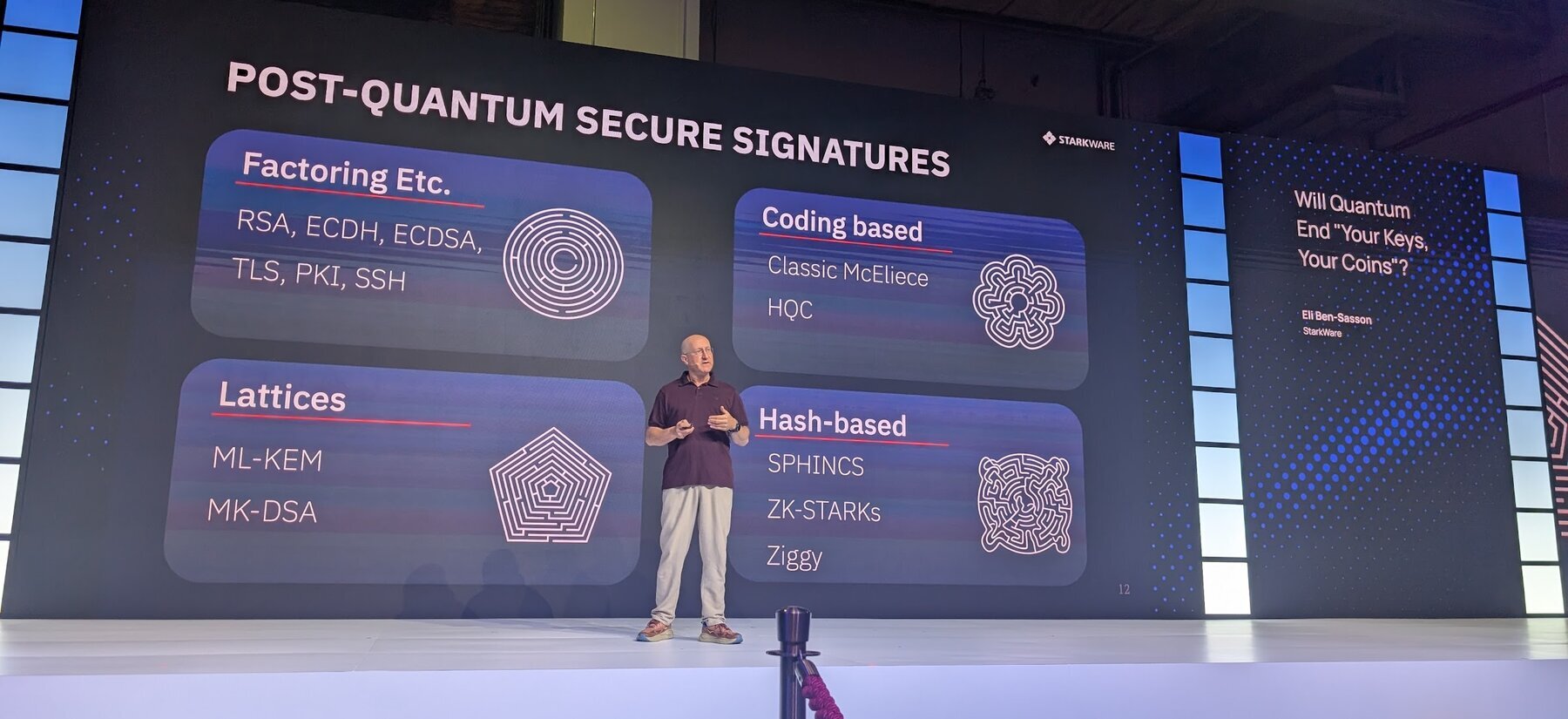
His slide sorted signature schemes into four families. ECDSA, which every ETC account signs with, sits in the box of schemes a quantum computer breaks, and the other three boxes hold the candidates to replace it, built on codes, lattices and hashes.
One post-quantum proposal open for ETC today, a draft ECIP discussed on Community Call 58, adds a precompile to verify ML-DSA, the lattice scheme on the slide. Lattices are a younger assumption than hash functions, and Vitalik Buterin’s reply to Drake singles them out (CoinDesk).
There is a good chance that the concrete security of lattices will take serious hits from the next two years of AI math.
Hash-based signatures, SPHINCS+ and STARK-based schemes, rest only on the hash function staying secure, which is the same assumption ETC’s proof of work already stands on. They cost more in signature size and gas, and we think ETC will need them anyway, either beside ML-DSA or in its place.
Ethereum is leading the way here, and its quantum-resistance roadmap moves validators to leanXMSS, a hash-based scheme, and uses account abstraction so that each account can switch signature scheme on its own.
Individual accounts could switch to a post-quantum signature scheme without waiting for the entire protocol to change.
ETC shares the EVM, and on post-quantum accounts we think the ETC community should follow Ethereum’s lead and adopt what it settles on.
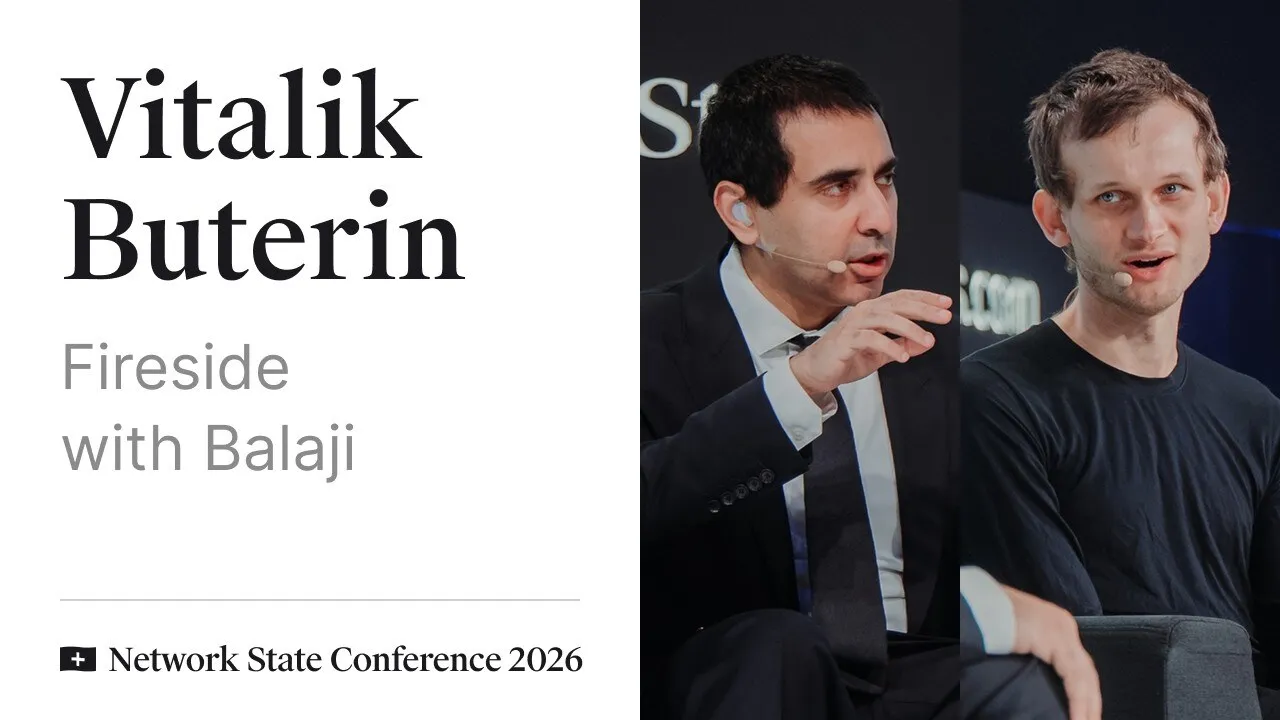
The day after TOKEN2049, Vitalik Buterin sat down with Balaji Srinivasan at the Network State Conference and came back to AI and cryptography. Crypto Briefing’s write-up has him seeing AI on both sides, with the same tools that speed up Ethereum’s work also helping attackers find weaknesses faster, and mathematical proofs of correctness as the safeguard. In the talk he pointed to the Ethereum Foundation’s strawmap, whose goals include a “post quantum L1” with “centuries-long cryptographic security, via hash-based schemes”. Balaji’s version, in one recap, was that every chain needs a defence budget, its own tokens spent on AI that keeps auditing its code and maths.
We agree that if AI is going to be pointed at ECDSA and at the code every client runs, the defence has to use AI too. Classix is already allocating defensive AI through Cybernetic Antibody Deployment, one of the Guerrilla Research Unit projects, with sentinels that detect, diagnose and neutralise vulnerabilities at machine speed.
Synergies
Talking to custodians, stablecoin issuers, exchanges and infrastructure providers at TOKEN2049 left us with three takeaways. Institutions need custody support before they can touch ETC, dollars on ETC should be native rather than bridged, and the public infrastructure around the chain decides whether integrations happen and stay.
Institutional Custody
Banks, funds and exchanges hold assets through custody platforms that split signing authority across machines and people, and an asset those platforms don’t support is one most institutions can’t buy. Cody Burns covered how these providers work with ETC in December 2025. Wider custody support for ETC, and for tokens issued on ETC, is what lets larger holders and new issuers use the chain at all.
Native Stablecoins
We want dollars on ETC that the issuer mints on ETC itself. A bridged token is only as good as the bridge behind it, because the real dollars sit locked on another chain under someone else’s keys. When the Multichain bridge stopped operating in July 2023 after its CEO’s arrest, the bridged USDT and USDC it had issued on chains including ETC could no longer be redeemed through it. A native token is redeemed by its issuer directly, with nothing in between to fail, and a trustworthy dollar is what payments, trading pairs and lending on ETC all start from.
Infrastructure and Integrations
Every exchange, wallet and app that touches ETC depends on nodes, RPC endpoints, explorers and price data, and most of them don’t run that stack themselves. They buy it from a small number of upstream providers, such as node and RPC services, custody and wallet-as-a-service platforms, wallet SDKs and price oracles, and many services further down the stack are built on top of each one.
That makes the upstream providers the place to start. Once one of them supports ETC, every service built on it can add ETC by switching it on, without its own integration work. Persuading those services one at a time takes far longer and reaches far fewer people.
Finding out where ETC can be bought, held and moved today is harder than it should be. Exchanges add and drop pairs, wallets stop supporting a chain without saying so, and the lists on community sites go stale within months. We want to update the website with AI crawlers that check exchanges, wallets and custodians on a schedule and keep the listings current, so anyone can see where ETC is listed and tradeable.
Emerging Narratives
TOKEN2049 left us with a few stories about ETC we’d like to try out, and we’ll be experimenting with them on our social media channels over the coming months.
The Hash-Secured EVM
ETC’s consensus is proof of work. Miners prove their work with ETCHash, built on the Keccak hash function, and no signature decides which chain is valid. Quantum computers weaken hash functions without breaking them, as Ethereum’s roadmap puts it.
Hash-based signatures are considered quantum-safe because they rely only on the security of hash functions, which quantum computers weaken but do not break.
Proof-of-stake consensus runs on validator signatures instead, and on Ethereum those are BLS signatures, which a large enough quantum computer breaks. Ethereum’s plan is to replace them with leanXMSS, a hash-based scheme whose signatures run to about 3,000 bytes against 96 for BLS. Every validator has to move to new keys, and every client has to handle signatures thirty times larger, on the largest EVM network while it keeps running. A change that deep to consensus is hard to get right, and a bug or a stalled rollout would land on every project built on top. ETC’s consensus layer already rests on hashing and needs no such migration.
That gives ETC something no proof-of-stake chain can offer, and the ETC community should lean into it. A project on proof-of-stake EVM chains can deploy the same contracts on ETC and keep a proof-of-work fallback, with the same tools and the same code, in case the migration goes wrong or a quantum computer arrives before it is done.
Narrative hot takes:
- Ethereum’s own roadmap says quantum computers “weaken but do not break” hash functions. Every ETC block is mined with ETCHash, built on Keccak, and no signature picks the valid chain.
- A quantum computer walks into an ETC block looking for a validator signature to break. There isn’t one.
- Does your EVM app have a plan if the move to post-quantum validator keys stalls? The same contracts deploy on ETC, chain ID 61, with proof of work underneath.
Programmable Parallel Polis
The cypherpunks of the early 1990s wrote the software they wanted to see, and Eric Hughes set out why in A Cypherpunk’s Manifesto.
We the Cypherpunks are dedicated to building anonymous systems. […]
Onward.
ETC was founded on the same instinct in 2016, when part of the Ethereum community kept running the original chain instead of following the hard fork that moved the DAO funds, and wrote a Declaration of Independence to say why. Nine days before the fork, Arvicco published A Crypto-Decentralist Manifesto, which ethereumclassic.org still carries, and it ends the way Hughes ended his.
We decentralists are committed to keeping blockchains open, neutral and immutable. […]
Onward.
Josh Swihart pitched Zcash as a parallel polis for money. ETC has the EVM, so a parallel polis on ETC can hold contracts as well as payments. Escrow, DAOs, token issuance and the rules of a group can all live on a chain that nobody gets to edit after the fact.
Narrative hot takes:
- Václav Benda’s parallel polis needed its own culture, education, information and economy. If you could put one of those in a smart contract today, which would it be?
- Eric Hughes ended A Cypherpunk’s Manifesto in 1993 with one word, “Onward.” Arvicco ended A Crypto-Decentralist Manifesto the same way on 2016-07-11, nine days before the DAO fork.
- Web3Privacy Now’s Ethereum Cypherpunk Congress meets in Mumbai on 2026-11-02, the day before Devcon. If you’re building institutions beside the old ones, tell the ETC community what you’d need from a chain nobody can edit.
Cross-Pollination
The ETC community is small, and it is stronger for the projects around it. Bitcoin proved that proof-of-work money can work, and ETC follows its lead, making it programmable. Ethereum built the EVM, most ETC upgrades have bundled its EIPs, and its post-quantum roadmap is the one we think the ETC community should follow. Zcash keeps showing what a proof-of-work chain can still invent, most recently with the preconfirmations in this post.
We respect all three, and we want the exchange to keep going both ways, with ETC people at other projects’ conferences, other projects’ ideas turning up in ECIPs, and ETC work that other chains can pick up.
Narrative hot takes:
- Preconfirmations were proposed for Zcash in September 2026 with no consensus change. The same design fits any proof-of-work chain, ETC included.
- Ethereum’s post-quantum plan moves its validators to hash-based signatures. ETC’s miners have been securing blocks with hashes since 2015.
- The 2016 fork split the chain, and the research kept flowing anyway. Most ETC upgrades since then have bundled Ethereum EIPs.
Onward
We went to Singapore to listen, and came home with more ideas than we expected, from Zcash’s preconfirmations to Ethereum’s post-quantum plans and the cypherpunk thread that runs through all of them. The next place those conversations happen is the Ethereum Cypherpunk Congress on 2026-11-02, the day before Devcon.
See you in Mumbai.