On 2015-04-13, three months before Ethereum’s genesis block, Vitalik Buterin published The Value of Blockchain Technology on the Ethereum Foundation blog.
Why are blockchains useful?
- You can run applications on them, and convince your users that your application will remain working even if you lose interest in maintaining it, you are bribed or threatened to manipulate the application state in some way, or you acquire a profit motive to manipulate the application state in some way
A year later, at block 1,920,000, Ethereum’s developers hard-forked the chain to manipulate the application state of The DAO. Every application kept working anyway, unmodified, on the chain that refused the change. That chain is Ethereum Classic, and it still exists. Vitalik was right.
Layer -1
Think of a blockchain as a building. Layer 1 is the tower, the protocol and the code that enforces it, the part users see and use. Layer 0 is the ground it stands on, the social layer of developers, miners, exchanges and users who decide which code to run.
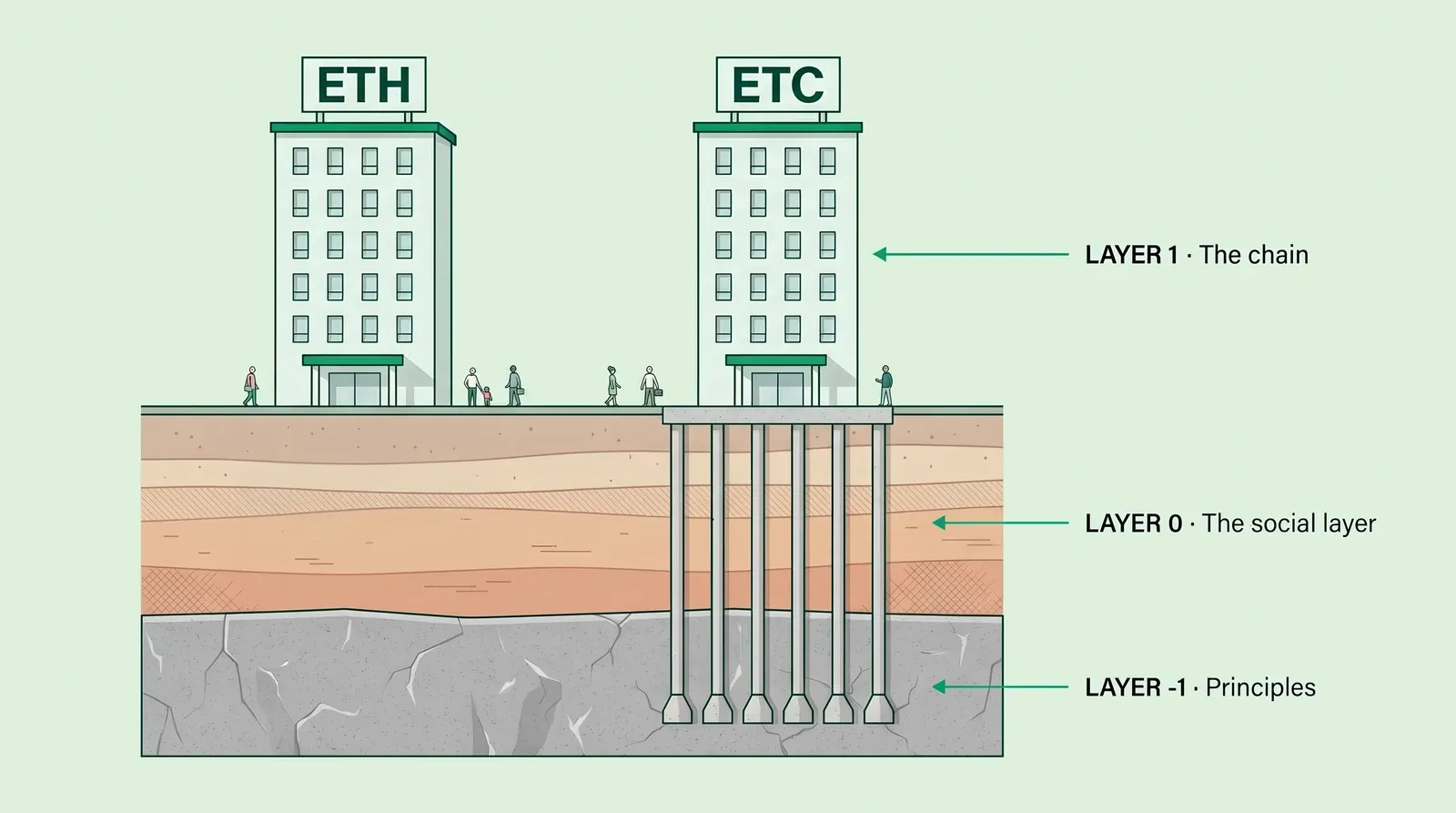
From the street, the two towers look the same. Both run the same kind of applications on the same virtual machine. The difference is underground.
A tower with no foundations rests on the soil, and soil moves. On almost every chain, there is nothing beneath layer 0. The rules are whatever the current social consensus wants them to be, and the current social consensus is whatever the loudest or best-funded faction can assemble.
Layer -1 is the bedrock, a set of principles beneath the social layer that doesn’t shift when the people above it do. For Ethereum it was Vitalik’s sentence above, published three months before the genesis block. It was there before the tower went up, and everyone who joined after joined on those terms. Piles driven down to it give the social layer something solid to build on. Developers, miners and users who disagree about a proposal can all measure it against the same bedrock, which turns “is this a good idea” into “does this contradict what the chain is for”, a question the social layer can organize around and settle.
Only a few chains reach bedrock. Bitcoin’s foundations were never set down in one document, but the Austrian economics it grew out of, sound money and distrust of anyone who can change the rules, is woven so deeply into its social layer that every proposal still has to answer to it.
Ethereum had bedrock under it and cut the tower loose at block 1,920,000, when the application state was manipulated. Ethereum Classic is the tower that stayed anchored, and within weeks its community reinforced those foundations with two founding documents. For ETC, layer -1 is the reason layer 1 is still standing.
This is why Vitalik was right. The promise didn’t depend on the people who made it. It sat beneath them, so when they changed their minds, the users it had convinced kept running the application without them.
Praxeology
Praxeology is the study of purposeful human action, as developed by the economist Ludwig von Mises, and the distinctive methodology of the Austrian School. It starts from an axiom nobody can deny without using it, and reasons forward. For Mises the axiom was that humans act, and anyone who argues otherwise is acting in the process of arguing, so the denial refutes itself in what is known as a performative contradiction. Because every conclusion follows deductively from an axiom that can’t be coherently denied, Mises could do economics without relying on statistics, and the conclusions hold for as long as no step in the reasoning is shown to be wrong.
Ethereum Classic can be reasoned about the same way. Start from the fact that blockchains exist and each principle follows from the one before it, down to refusing the DAO bailout, keeping Proof of Work and rejecting a treasury. Deny any step and you are left with just an inefficient traditional database, or with a proposal that defeats itself.
The reasoning below is the same reasoning as the Why Classic section of ethereumclassic.org, which Classix co-founder Istora wrote in 2022, and the two founding documents of Ethereum Classic it rests on, A Crypto-Decentralist Manifesto and The Ethereum Classic Declaration of Independence.
The table below lays out the whole argument. The left column is the chain of deductions, starting with Mises’s axiom and then ours. The right column pairs each deduction with a proposal that relies on it while denying it, which removes any reason to make the proposal.
| Deduction | Contradiction |
|---|---|
| Humans Act Every argument is itself an action. | Humans Don’t Act Saying so is an action. |
| Blockchains Exist Thousands of nodes run blockchains, and people pay fees to have transactions included. | Blockchains Don’t Exist Broadcasting this claim in an Ethereum Classic transaction refutes it. |
| Unstoppable Applications A blockchain is a worse database, worth paying for because nobody can stop the applications on it. | Irregular State Transition A hard fork that rewrites contract state by decree, as The DAO fork did, stopping an application mid-run. |
| Sovereign Grade If one organization can stop a chain, the chain is that organization’s fancy inefficient database. | Permissioned Operation Users who pay for a permissionless blockchain actually get a database run by whoever grants the permission. |
| Protocol Neutrality A privileged party can be pressured, and a party that can be pressured is a way to stop the chain. | Protocol-Privileged Parties Whoever decides who gets the privilege can be pressured, which neutrality exists to prevent. |
| Ossification Every hard fork is a window for capture. Fewer forks, fewer windows. | Non-Technical “Upgrades” Hard forks with no technical reason, like The DAO fork. Each one reopens a capture window. |
| The Founding Documents The Manifesto and the Declaration fix these principles as the reason ETC exists. | Amend or Ignore the Principles Stands on the chain the principles created while repealing or ignoring the principles. |
| Classix and Other Teams Explicitly not official. Voluntarily funded and in open competition with better teams. | Ethereum Classic DAO / Foundation An official body, on a chain with no official anything. One team to capture, and the chain goes with the team. |
The Axiom
Like Mises, we start from an axiom that can’t be denied, and derive everything else from it by reasoning from first principles. The axiom is this.
Blockchains exist.
Say blockchains don’t exist, and anyone can prove you wrong by having a transaction included on Ethereum Classic. Thousands of nodes are running one right now, and people pay fees every day to have their transactions included in it.
A blockchain is a slow, expensive, redundant database. Every node stores everything and executes everything, and thousands of machines agree on each state change. Measured as a database, it is outperformed by a single conventional database server.
People act on purpose. The only reason someone would pay extra for a worse database is for the extra property that a traditional database can’t provide, which is that nobody can stop a sovereign grade blockchain. Nobody can edit it, freeze an account in it, or roll it back, because there is nobody in charge of it to ask. Applications run exactly as programmed, and Code is Law.
So the first deduction is that blockchains exist for unstoppability, meaning censorship resistance, and for nothing else. If you don’t need that, AWS is cheaper and faster. Any property a chain trades unstoppability away for is a property a database already had.
Unstoppable Against Anyone
Unstoppable has to mean unstoppable by anyone. Suppose one organization can stop the chain. It could be a government, a company, a foundation, or the chain’s own developers. Then that organization has the final say over what the chain records. Every transaction goes through only because this controlling organization allowed it to.
This begs the question of why you’d need a blockchain at all. The organization could run Postgres and get the same result for a fraction of the cost. Everyone else is paying for a blockchain and getting that organization’s database.
So a chain that someone can stop fails the first deduction. It no longer offers the one thing that justified its cost. It doesn’t matter whether that someone ever uses the power. Once one party can stop the chain, users are trusting that party, which is what a traditional database already asks of them.
How unstoppable a chain needs to be depends on who would want to stop the applications running on it. Vitalik’s answer at the top of this post already names the threats, a maintainer who loses interest, is bribed or threatened, or finds a profit motive to manipulate the application state. Applications that move money or compete with existing institutions attract the parties best placed to do the bribing and threatening. Holding out against them takes Sovereign Grade censorship resistance, where no nation state, company or foundation can stop the chain.
Below that line, the chain is a fancy database controlled by whoever can stop it.
Decentralization Everywhere
A blockchain is only as decentralized as its most centralized bottleneck, and an adversary will go after whichever one is easiest. Every part of the stack needs redundancy, several independent options rather than one, so that capturing or losing any single one doesn’t stop the chain. That includes:
- Client implementations and the teams that sign their releases
- Mining hardware manufacturers
- Mining pools
- Exchanges and on-ramps where people turn money into coins
- RPC endpoints and explorers that users reach the chain through
- Sources of funding for developers
While temporary single points of failure in the social layer may be necessary to carry things while no alternatives exist, it is the job of the social layer to find them and keep reducing them, until no single party is worth capturing.
Neutrality
For a chain to stay decentralized over time, it has to stay neutral at the protocol layer. It cannot grant any party special privileges.
The reason is incentives. If the protocol pays one group through a premine, a dev tax or a treasury, that group becomes the obvious place to organize around, and the obvious thing to capture. Everyone else contributes on worse terms, so fewer of them do, so the project leans harder on the privileged group. That is a centralization gravity well, and projects rarely climb out of one.
A neutral protocol treats every participant the same. Mining on Ethereum Classic shows what that looks like. The protocol doesn’t know who a miner is. Anyone with hardware and electricity can produce a block, and the block reward goes to whoever produced it, with no cut set aside for a foundation or a treasury. Miners compete hard with each other, but from the protocol’s side the field is level.
The first line of our manifesto says that a protocol that grants special privileges loses its reason for being. Whoever the protocol privileges can be pressured to stop the chain, and neutrality leaves no one in that position.
Ossification
Between hard forks, the social layer can’t touch the chain. A hard fork is the moment it reaches through and changes layer 1 directly, which exposes the chain to whatever pressure the social layer is under at that moment, so every fork is a window for capture. The more often a chain forks, the more of those windows it opens, which is why the barrier to forking has to be high enough that no window is opened unless it has to be. The protocol aims to ossify, changing less over time until the only forks left are the ones that keep the technology working.
The Ethereum Classic Declaration of Independence drew that line in 2016, permitting “forks and/or changes to the underlying protocol” only “for updating or upgrading the technology on which Ethereum Classic operates”. It was written in response to The DAO fork, which had no technical reason behind it. A non-technical “upgrade” opens a capture window with no engineering benefit to show for it, and every one that passes makes the next easier to argue for. Proof of Work is the clearest example of what ossification protects, a consensus rule anyone can take part in without permission, which stays settled rather than being reopened at each fork.
The Founding Documents
None of the reasoning outlined above is new. Early ETC contributors wrote these ideas down within weeks of the DAO fork. A Crypto-Decentralist Manifesto, 2016-07-11, holds that openness, neutrality and immutability make a blockchain worth having, and that all three depend on decentralization. It sets the bar for changing the rules.
The rules governing the blockchain network are known in advance. They’re exactly the same for everyone and not subject to change other than with 100% consensus.
The Ethereum Classic Declaration of Independence, 2016-08-13, fixes the purpose of the chain and how its principles are to be treated.
the purpose of Ethereum Classic is to provide a decentralized platform, that runs decentralized applications, which execute exactly as programmed without any possibility of downtime, censorship, fraud or third party interference
We encourage that these principles not be changed via edict by any individual or faction claiming to wield power, authority or credibility to do so.
That is the whole chain of reasoning, written down ten years ago by the people who kept the chain alive.
At block 1,920,000, the rest of Ethereum adopted a hard fork that moved the ether held by The DAO and its child DAOs, including the attacker’s, into a refund contract.
The people who stayed on the original chain did so because rules that can be changed once to bail out one group can be changed again for anyone with enough influence. Every block since then is evidence that the principles could not be moved by the social layer, even when most of it wanted them to be. The founding documents record why, which makes them different from a mission statement a company can revise.
That is why certain proposals are inconsistent with this chain in particular.
An irregular state change, a hard fork that moves funds or rewrites contract state outside the rules the contracts were deployed under, is the act Ethereum Classic split away to refuse. A version of ETC that makes one has made the choice Ethereum made in 2016, and becomes a second copy of the chain it left.
Granting a party a share of every block breaks the Manifesto’s rule that the rules are “exactly the same for everyone”. It also ignores the Declaration, which already settled how development gets funded, by anyone who chooses to, project by project.
Changing the principles by edict claims the one power the Declaration denies to “any individual or faction claiming to wield power, authority or credibility”. Whoever holds that power governs the chain, and the principles become whatever that party says they are. This is exactly what happened to Ethereum Mainnet, and exactly what Classic exists to oppose.
Each of these proposals can only be made on Ethereum Classic because the principles held long enough for the chain to survive, and each one asks the chain to give them up. Each proposal that contradicts the founding documents defeats its own purpose, which makes it a performative contradiction. If you want different principles, you are free to fork and build them elsewhere. You are not free to rewrite this chain’s reason for being and keep its name.
What Follows for Classix
Classix is a small team that formed this year to maintain clients, run public infrastructure and fund development for Ethereum Classic as the ETC Cooperative winds down. An organization is the kind of bottleneck the steps above warn about, so the test for anything we take on is whether it leaves Ethereum Classic depending on us.
Classix shares the same philosophical bedrock as Ethereum Classic, and it shapes how we work. Anything we run is published so that anyone else can run it, we are funded voluntarily and never by a cut of the protocol, we publish our reasoning and evidence so that nobody has to trust us, and we favor keeping the existing rules secure over adding new ones, especially when they aren’t strictly technical upgrades. Classix is explicitly not official, and we don’t speak for the chain.
We want other teams building clients, running infrastructure and funding development in open competition with us, on an equal footing, because a chain with one team has one point of capture, whoever that team is. Success for us looks like Classix mattering less over time, with the chain coming out of this period with more independent operators, more people who can build and review the clients, more infrastructure anyone can stand up, and no new privileged party.